
Loading shoe lifespan
Loading shoe lifespan
~570 km
Expected lifespan, based on hand-researched wear data for this model.
Got a pair? Check how much life is left.
Free, 4 quick questions with this shoe pre-selected. Wear percentage, km remaining, and what your pair is worth.
Check your Challenger ATR 5 →No Challenger ATR 5 listed right now.
Be first in line — we'll email you the moment a pair in your size lists.
The dual-layer mesh upper with TPU overlays is noted as an improvement over previous versions, addressing earlier durability concerns. Most reviewers report good longevity for moderate trail use, but some mention that the outsole lugs wear faster on pavement and that the shoe is not ideal for highly technical or muddy terrain, which may impact long-term durability.
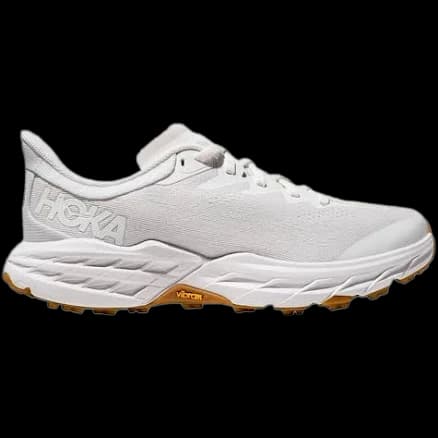
The Hoka Challenger ATR 5 is widely regarded as a versatile, cushioned, and lightweight trail shoe that performs well for daily training and moderate trail running. Experts highlight its comfort, moderate weight, and ability to transition between road and trail, making it ideal for everyday runs and recovery efforts. Its cushioning and support are praised for longer efforts, though some reviewers note it is not as energetic or responsive as dedicated tempo or racing shoes, limiting its suitability for fast-paced workouts and competitive events. The outsole provides good traction on dry, packed, or moderately technical trails, but shorter lugs and less aggressive tread reduce performance on wet, muddy, or highly technical terrain. User and expert feedback consistently recommend it for easy and long runs, especially for those seeking comfort and versatility, but not for technical trail racing or speedwork.
Ideal for Best suited for intermediate to experienced runners who value comfort and versatility over technical precision. Ideal for those who train on a mix of roads and non-technical trails, prioritize long-distance cushioning, and prefer a lightweight, neutral shoe for daily mileage or ultra training.
The Challenger ATR 5 is designed for comfort over long distances and mixed terrain, prioritizing cushioning and upper volume over technical precision. The fit is best for runners seeking a roomy, accommodating trail shoe rather than a snug, technical fit. The shoe is not recommended for highly technical trails due to its less secure midfoot and overall upper volume.
Sizing: Generally true to size; available in standard and wide widths. Fit is similar to ATR 4, but with more upper volume. Most users do not need to size up or down, but those with very narrow feet may find it roomy.
Recovery shoes in NORMA's database last between 480 and 800 km across 60 models. At 570 km, the Hoka Challenger Atr 5 sits in the lower half of that range.
The Hoka Challenger ATR 5 delivers plush cushioning and a lightweight feel, making it a standout for runners who split time between roads and moderate trails. Its roomy fit and durable upper enhance comfort for longer outings, though those tackling technical terrain may want more precise lockdown and aggressive grip. For runners seeking a reliable, all-terrain daily trainer, the ATR 5 offers a compelling blend of comfort and versatility.
Full specs, fit notes, and reviews on the Hoka Challenger Atr 5 wiki page.
NORMA's marketplace is UK-only today. Tell us where you are and we'll let you know the moment we open your region.
The Hoka Challenger Atr 5 lasts about 570 km, based on hand-researched wear data for this model. Your own mileage shifts with body weight, running surface, and how you use the shoe.
Start checking for wear around 342 km (60% of its lifespan). By 456 km the foam and outsole are usually noticeably degraded, and most runners retire the shoe between there and 570 km.
Recovery shoes in NORMA's database range from 480 to 800 km across 60 models. At 570 km, the Hoka Challenger Atr 5 sits in the lower half of that range.
Often, yes. A pair with under 60% wear (roughly 342 km) still has real training life left. NORMA lists second-rotation running shoes with transparent, verified mileage so you know exactly how much life you're buying.